
This page is a question-and-answer toolkit for transport planner interviews: likely questions grouped by type, worked model answers using the STAR method, and a 48 to 72 hour checklist you can run through before you walk in. Prioritise three things as you prepare: two or three STAR examples drawn from real projects, a project you can talk through confidently without slides, and a short, honest note on a technical gap you’re closing. Use the checklist in this piece as your final run-through the night before.
TL;DR:
- Prepare three STAR examples from real projects that demonstrate your decision-making and measurable impact to answer behavioral questions confidently.
- Be ready to discuss your experience with specific data sources, modelling tools, and appraisal methods, explaining how you validate and choose them for different schemes.
- Practice brief, timed presentations on a relevant project, rehearsing clear defense of your decisions within ten minutes to handle professional review interviews effectively.
- Clarify your understanding of stakeholder engagement techniques and funding considerations, emphasizing how you address safety, accessibility, and bias in transport planning.
- Verify logistics, technical materials, and tailor your language to the role while asking specific questions about projects or team structure at the end of the interview.
Table of Contents
- 1. Common transport planner interview questions by category
- 2. Answering behavioural questions with the STAR method
- 3. Technical questions: data, modelling and software
- 4. Written exercises, professional reviews and presentations
- 5. Model answers you can adapt
- 6. Your 48 to 72 hour interview checklist
- 7. Showing stakeholder, funding and safety thinking
- 8. Reading company culture and values in the room
- 9. Questions worth asking the interviewer
- 10. Red flags to watch for in a transport planner role
- Recruiter perspective: what stands out in successful candidates
- Jobs-in-Transport.com: find transport planner roles and host your CV
- FAQ
- Sources
1. Common transport planner interview questions by category
Interviewers tend to move through a predictable sequence: warm-up questions about your background, then project-specific questions, then stakeholder and technical probing, before finishing on demand-responsive travel logistics. Knowing the shape of the conversation lets you prepare answers rather than guess at them. The National Careers Service transport planner profile frames the role around discussing transport methods, costs and benefits, analytical thinking and writing reports for planning authorities, which is a useful guide to what interviewers will want to hear echoed back.
- Opening and CV-based questions: tell us about yourself, why transport planning, why this role or organisation, talk us through a gap or change in your CV.
- Project and planning questions: describe a transport plan or scheme you developed, how did you balance competing priorities, what would you do differently now.
- Stakeholder and consultation questions: how have you handled a difficult stakeholder, how do you run a consultation, how do you communicate technical findings to a non-technical audience.
- Technical questions: which modelling or GIS tools have you used, how do you validate data, how do you choose a model or appraisal method for a given scheme.
- Logistical questions: working hours, travel expectations, willingness to attend site visits, right-to-work or vetting checks, notice period.
Junior candidates are usually asked more about coursework, placements and willingness to learn; senior candidates get more scrutiny on trade-offs, team leadership and how they have defended a recommendation under pressure. Either way, map two or three of your own projects against this list before the interview so you are never reaching for an example on the spot.
A smaller but common thread is motivation. Panels want to know whether you understand what the organisation actually does, not just that you want “a job in transport”. If you are applying through a sector job board, read the full vacancy and employer profile rather than skimming the job title, since the detail often hints at what the panel will probe first.
2. Answering behavioural questions with the STAR method
STAR stands for Situation, Task, Action, Result: a structure that stops answers drifting into vague description and forces you to show what you actually did and what changed because of it. The Department for Transport’s apprenticeship career accounts recommend STAR specifically for behavioural questions, and panels trained on competency frameworks are listening for exactly that shape.
- Situation: set the scene in one sentence, naming the scheme, team or constraint.
- Task: state what you were responsible for, not what the team did generally.
- Action: describe the specific steps you took, including any disagreement or trade-off you navigated.
- Result: close with what happened, what you learned, and what you would adjust next time.
A junior example: during a university or placement project, you identified that pedestrian counts at a junction contradicted the client’s assumption; you flagged it, re-ran the count at a different time, and the revised figure changed a design decision.
A mid-level example: you led consultation on a residential parking scheme, faced objections from a resident group, adjusted the proposal to protect a disabled parking bay, and got the scheme through committee with reduced objection numbers.
A senior example: you were asked to choose between two appraisal methods for a bus priority scheme, justified your choice to a sceptical funding panel, and the scheme secured approval on the first submission.
Scale the complexity of your example to the seniority of the role: a junior candidate showing initiative on a small task reads just as well as a senior candidate showing judgement on a contested decision, provided the result is concrete. Recruiters are listening for clarity, ownership (use “I”, not only “we”), and proof that something measurable changed.
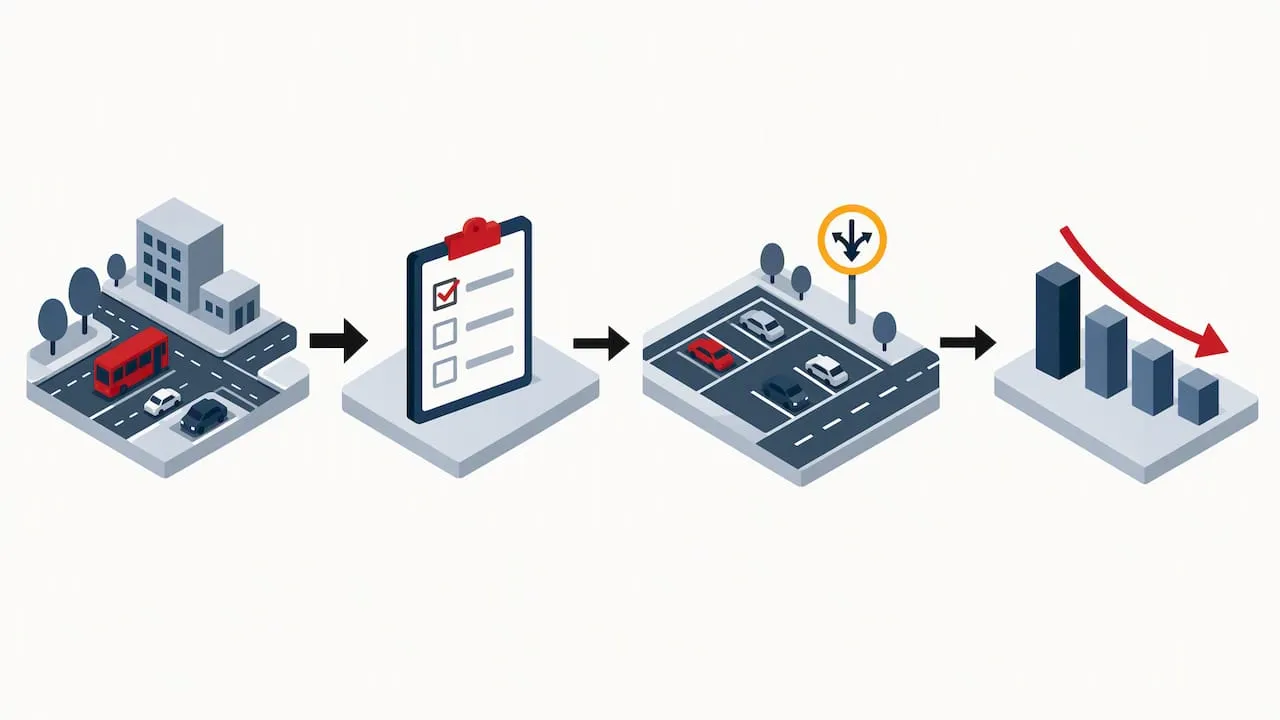
Pro Tip: End every STAR answer with a result, even a modest one: “we revised the layout” is weaker than “we revised the layout and objections dropped from twelve to three”.
3. Technical questions: data, modelling and software
Technical questions test whether you understand the limits of your tools, not just their names. The Skills England transport planner apprenticeship standard lists statistics, digital software, modelling, forecasting and evaluation as core occupational skills, and interviewers commonly probe data suitability: sample size, representativeness, and whether a particular data source (police collision records, operator patronage data) is actually appropriate for the question being asked.
- How do you validate a model or dataset? Explain calibration against observed counts, note any known bias in the source, and say how you would sense-check an unexpected result.
- Which software have you used? Name the GIS or modelling packages you have genuinely used and be ready to describe one limitation you hit, rather than listing tools you have only seen demonstrated.
- How would you choose an appraisal method? Tie your answer to the scheme type: a junction redesign needs different evidence from a strategic transport plan.
- What would you do if the data contradicted the brief? Describe a structured way of flagging the discrepancy rather than simply overriding it.
Keep a short, specific list of terms you can define in one sentence each: calibration, validation, elasticity, mode share, induced demand. You do not need to sound like a textbook, but stumbling on a term you have listed on your CV is a bad sign to a panel.
If you are asked about a weakness, name one real technical gap, for example limited exposure to a particular forecasting package, and follow it immediately with what you have done about it: a short course, a side project, or a colleague you have shadowed. Our guide to transport planning principles and impacts is a useful refresher on appraisal and multimodal considerations if you want to sharpen the vocabulary before the interview.
4. Written exercises, professional reviews and presentations
Many transport planning roles, particularly in the public sector or at larger consultancies, add a written exercise or presentation to the usual interview. Glassdoor and Indeed interview reports on roles such as AECOM’s transportation planner position commonly describe a mix of HR screening, a technical interview and an occasional written task, and the DfT’s own apprentice accounts mention a personal statement and written exercise as standard stages.
- Written exercise or timed brief: usually a short scenario (a junction problem, a consultation response) that tests prioritisation and clear writing under time pressure.
- Professional review interview: for CIHT-accredited routes, this can include a timed project presentation followed by detailed technical questioning.
- Panel or technical interview: the main event, mixing behavioural and technical questions.
CIHT’s own guidance note on professional review describes a 10-minute project presentation followed by questions on technical competence and cross-modal knowledge, which is a useful template even if your interview is not formally a CIHT review: pick one project, build no more than five slides, and rehearse defending your trade-offs out loud.
Pro Tip: Time yourself against a phone timer at least twice before the real thing: most candidates run long on the first attempt and cut the result section short.
5. Model answers you can adapt
These are short templates, not scripts; swap in your own detail and keep the length close to what is suggested.
- Tell me about yourself (30 to 45 seconds): your current role or course, one project that shows your interest in transport planning, and why this particular vacancy caught your attention.
- Describe a transport plan you developed: a condensed STAR answer, one sentence per stage, ending on a measurable result.
- How do you choose a model or validate your data?: name the data source, the check you ran, and the adjustment it produced.
- Tell me about a stakeholder conflict: who disagreed, what you changed or held firm on, and how the scheme ultimately progressed.
Keep each answer under ninety seconds unless asked to go deeper. Panels tailor questions to the vacancy, so adjust your examples to match the mode (highways, rail, active travel) named in the job advert rather than reusing one generic story for every question.
6. Your 48 to 72 hour interview checklist
- Assemble your evidence: two or three STAR examples, a portfolio piece or project slide, and your CV annotated with dates and outcomes.
- Check your technical kit: confirm files open, charge your laptop, and save offline copies of any maps or screenshots you plan to reference.
- Rehearse against the clock: run your STAR answers aloud, time your presentation, and ask a colleague for a mock interview if you can.
- Sort logistics: confirm travel time and contact details, and prepare two or three questions of your own to ask at the end.
- Tailor your language: match terms in your CV and answers to the vacancy wording; our piece on job ad language is a useful check if you are unsure which keywords matter.
7. Showing stakeholder, funding and safety thinking
Strong answers on stakeholder engagement name a specific technique (survey, focus group, workshop), acknowledge that each method carries its own bias, and describe what you did to correct for it, a structure the CIHT knowledge appendix sets out directly. Weak answers simply say “we consulted the public” with no sense of who was actually reached or missed.
Funding and feasibility questions test whether you think beyond the drawing board: who pays, what the likely objection from a finance or committee audience would be, and whether the benefits justify the cost. You do not need detailed costings in an interview, but you should be able to say, in general terms, how a scheme you worked on was funded and what constraint shaped its design.
Safety and accessibility should appear unprompted in at least one answer, not only when directly asked. CIHT frames transport planning as inherently multimodal with links to public health, so mentioning who benefits from a scheme, who might be disadvantaged (older people, disabled users, cyclists sharing space with traffic) and how you addressed that signals the kind of judgement panels are trained to look for.
8. Reading company culture and values in the room
An interview runs in both directions. Notice how the panel talks about past projects: do they mention trade-offs and lessons learned, or only successes? A team that can describe a scheme that did not go to plan, and what they changed, is usually more candid about day-to-day working conditions than one that offers only polished wins.
Pay attention to how decisions get made. Ask who signs off a recommendation and how disagreements within the team are resolved; the answer tells you whether planners have real input or simply produce reports for someone else’s decision. If the panel seems unable to describe this clearly, treat that as useful information in itself.
Notice the makeup of the panel too. A mix of technical and non-technical interviewers suggests a team that works across disciplines; an entirely technical panel may signal a narrower, more siloed role.
9. Questions worth asking the interviewer
Save two or three questions for the end, and make them specific rather than generic. Asking about a named project (“what’s the current status of the scheme mentioned in the advert?”) shows you read the brief closely and gives you a clearer sense of the actual work.
Ask about team structure: how many planners work on a typical scheme, and how much contact you would have with engineers, consultees or clients. This answer tells you whether the role is hands-on delivery or mostly desk-based modelling.
A question about professional development, such as support towards CIHT membership or further technical training, is a fair and expected thing to raise; it signals ambition without sounding transactional. Avoid asking only about salary or holiday at this stage; save those for an offer conversation.
10. Red flags to watch for in a transport planner role
A vague job description that lists “transport planning duties” without naming a mode, scheme type or team size often means the role itself is loosely defined, which can mean broader but shallower responsibility than advertised.
Be cautious if the panel cannot explain who the role reports to, or gives inconsistent answers about team size between the advert and the interview. The same caution applies if nobody can describe a recent project in any detail: it may suggest limited delivery experience within the team.
Watch for unclear expectations around site visits, on-call duties or travel. A role that significantly understates travel or irregular hours compared with what is later expected is a common source of early dissatisfaction, so ask directly if the advert is ambiguous.
Recruiter perspective: what stands out in successful candidates
The gap we see most often is not technical weakness: it is candidates describing a project without ever saying what changed because of their work. The strongest applicants bring one clear delivery example, a visual they can talk through without reading from it, and honesty about where their experience ends. Searching by sector rather than generic job titles on a platform like our about us page describes also tends to surface roles that match a candidate’s actual specialism faster than a general jobs site.
— Rob
Jobs-in-Transport.com: find transport planner roles and host your CV
We list transport planner vacancies alongside highways, rail, bus and logistics roles, so you can search by specialism rather than scrolling a generic jobs site. Our online CV hosting keeps your profile visible to employers browsing for candidates, and job alerts flag new postings that match your search as soon as they go live.
Once your STAR examples and checklist are ready, put them to use: browse current transport planner vacancies and host your CV so employers searching the sector can find you directly.
FAQ
How many questions are usually asked in a transport planner interview?
There is no fixed number, but most panels cover five to eight questions across background, project experience, stakeholder handling and technical competence within a thirty to forty-five minute slot. Public-sector or consultancy interviews often add a written exercise or presentation as a separate stage, as described in the DfT’s own apprentice career accounts.
What is the STAR method and why do interviewers ask for it?
STAR stands for Situation, Task, Action, Result, a structure that forces you to show what you specifically did and what outcome followed, rather than describing a project in general terms. The Department for Transport explicitly recommends STAR for behavioural questions in its apprenticeship career guidance.
What skills do interviewers most want to see in a transport planner?
Panels typically look for analytical and modelling ability, comfort with relevant data and software, and clear communication with non-technical stakeholders, skills the Skills England apprenticeship standard lists as core to the role. Equally important is evidence of judgement: knowing when data is unreliable and how you handled that in practice.
How should I prepare for a presentation or professional review interview?
Build a short presentation, around five slides, around a single project you know well, and rehearse defending your trade-offs out loud against a timer. CIHT’s professional review guidance describes a ten-minute project presentation followed by detailed technical questioning as a common format worth practising against.


