
Most traffic engineers enter the profession confident they know what their role demands. Then they sit across from a hiring manager who asks about C-V2X communication protocols, stakeholder consultation strategies, or PTOE certification requirements, and the gaps become obvious. The skills for traffic engineers have shifted considerably over the past decade, and the gap between what many practitioners know and what employers now expect is wider than most realise. This guide covers the full picture: qualifications, technical tools, emerging technology competencies, and the soft skills that separate engineers who advance from those who plateau.
Table of Contents
- Essential educational background and certifications for traffic engineers
- Technical skills: analysis, modelling, and software proficiency
- Emerging technologies and data analytics in traffic engineering
- Practical challenges and soft skills for effective traffic engineering practice
- Summary table of core skills for traffic engineers and their application
- Why mastering both operational expertise and soft skills is vital for traffic engineers
- How Jobs-in-Transport.com supports your traffic engineering career growth
- Frequently asked questions
Key Takeaways
| Point | Details |
|---|---|
| Formal education required | A Bachelor’s degree in Civil or Transportation Engineering is the baseline for traffic engineers. |
| Certifications boost careers | Certifications like PTOE validate expertise and often lead to better job opportunities. |
| Software proficiency essential | Mastery of traffic modelling tools such as Synchro and VISSIM is critical for practical engineering work. |
| Emerging tech knowledge | Understanding ITS, communications, and cybersecurity is increasingly important in modern traffic engineering. |
| Soft skills matter | Effective communication and stakeholder engagement are vital for successful project delivery. |
Essential educational background and certifications for traffic engineers
Strong traffic engineer expertise starts with formal education. A Bachelor’s degree in Civil Engineering or a closely related discipline such as transportation engineering or urban planning is the standard entry point. From there, the path diverges depending on your ambitions.
The Professional Engineering (PE) licence is the credential that unlocks senior-level responsibility. It is often required for engineers who sign off on designs and engineering reports. Without it, you are limited in what you can formally authorise, regardless of experience. Gaining the PE typically requires passing the Fundamentals of Engineering (FE) exam, accumulating four or more years of progressive experience, and passing the Principles and Practice of Engineering (PE) exam.
Beyond the PE, the traffic engineering profession has its own specialist certification:
- Professional Traffic Operations Engineer (PTOE): Administered by ITE, this credential confirms you can independently manage traffic operations. It typically requires between four and eight years of relevant experience.
- Professional Transportation Planner (PTP): Relevant if your work spans land use planning and transport modelling, not just operations.
- Road Safety Professional (RSP): Increasingly valued as road safety audits become mandatory on larger infrastructure schemes.
- ITE membership: While not a licence, active ITE membership signals professional engagement and gives access to technical resources and peer networks.
Here is the standard progression most traffic engineers follow:
- Obtain a Bachelor’s degree in Civil Engineering or transportation-related discipline.
- Gain entry-level experience and sit the FE exam.
- Accumulate required experience hours and obtain PE licensure.
- Pursue PTOE certification once experience thresholds are met.
- Add specialist credentials (RSP, PTP) aligned with your project focus.
Understanding core competencies for traffic engineers at each stage helps you plan your development intentionally rather than reactively.
Technical skills: analysis, modelling, and software proficiency
This is where most practitioners feel most comfortable, and yet it is also where knowledge goes stale fastest. Traffic data collection and quantitative analysis remain the backbone of the discipline. You need to conduct traffic volume counts, level of service analysis, speed and crash data reviews using standardised methodologies before any modelling work begins.
The software tools that employers consistently require include:
- Synchro: Industry-standard for signal timing analysis and optimisation of signalised intersections.
- VISSIM: Microsimulation software used to model vehicle interactions, pedestrian flows, and complex junction behaviour.
- Highway Capacity Manual (HCM) methodologies: The analytical framework underpinning capacity and level of service calculations across the UK and internationally.
- SIDRA Intersection: Widely used for roundabout and intersection performance analysis.
- AutoCAD or MicroStation: For producing geometric design drawings embedded within traffic studies.
What many engineers underestimate is that operating software is the easy part. What actually distinguishes experienced practitioners is the ability to interpret model outputs critically. A VISSIM model can produce results that look technically plausible but are operationally nonsensical if the input assumptions are wrong. Knowing how to validate, calibrate, and challenge model outputs is a traffic design skill that employers genuinely value.
| Software tool | Primary application | Skill level required |
|---|---|---|
| Synchro | Signal timing and capacity analysis | Intermediate to advanced |
| VISSIM | Microsimulation and junction modelling | Advanced |
| HCM methodology | Capacity and level of service analysis | Intermediate |
| SIDRA Intersection | Roundabout and intersection analysis | Intermediate |
| AutoCAD / MicroStation | Geometric design drawings | Intermediate |

Pro Tip: When preparing for interviews or updating your CV, specify the version of software you have used and the scale of projects it was applied to. “Experience with VISSIM” tells an employer very little. “Built and calibrated a VISSIM microsimulation model for a 14-junction town centre network” tells them everything they need to know.
Broadening your understanding of transport planning principles alongside these tools gives your analysis context that purely technical engineers often miss.
Emerging technologies and data analytics in traffic engineering
This is the section most career guides skip entirely, and that omission is precisely why so many traffic engineers find themselves underprepared for modern roles. Intelligent Transport Systems (ITS) are no longer peripheral to the job. They are central to it.
ITS competencies require understanding communications protocols like Dedicated Short-Range Communications (DSRC) and Cellular Vehicle-to-Everything (C-V2X), the two dominant standards for connected vehicle communication. These are not niche areas reserved for technology specialists. Traffic engineers are expected to specify and review ITS deployments, which means understanding how data flows between vehicles, infrastructure, and traffic management centres.
Key emerging competencies to build include:
- Adaptive signal control systems: Understanding how systems like SCOOT or SCATS differ from fixed-time plans, and when each is appropriate.
- Big data analytics: The ability to process and interpret large datasets from sources including Bluetooth sensors, ANPR cameras, and mobile phone data.
- Cybersecurity awareness: Transport infrastructure is increasingly connected and increasingly targeted. Engineers must understand threat models and data protection obligations.
- Connected and autonomous vehicle (CAV) readiness: Understanding how CAVs will interact with existing signal infrastructure.
“Traffic engineers who understand both the physical network and the data layer that runs across it are significantly more employable than those who understand only one.”
Pro Tip: You do not need to become a cybersecurity expert. You do need to understand enough to ask the right questions during procurement and to identify red flags in system designs. A one-day ITS fundamentals course from a recognised provider is often enough to build this working knowledge.
Keeping pace with modern traffic engineer skills in this area is no longer optional for anyone serious about career advancement.
Practical challenges and soft skills for effective traffic engineering practice
Here is the uncomfortable truth: brilliant engineers lose projects and miss promotions because they cannot communicate. Technical mastery means nothing if you cannot explain a signal timing change to a frustrated local councillor or defend a junction capacity assessment to a planning inspector. Soft skills for engineers are not peripheral niceties; they are operational requirements.
The soft skills most critical to traffic engineering practice include:
- Technical report writing: Clear, well-structured Transport Assessments, Transport Statements, and Traffic Impact Analyses that non-specialists can follow.
- Public consultation and engagement: Public participation and collaboration across departments are mandatory on most major schemes, and poorly managed consultations cause delays that cost far more than the consultation itself.
- Multidisciplinary collaboration: Traffic engineers rarely work in isolation. You need to coordinate effectively with highways engineers, planners, environmental consultants, and local authority officers.
- Presentation skills: Presenting findings to committees, clients, and public audiences requires a different register than writing a technical report.
- Risk awareness: Understanding legal frameworks including compulsory purchase procedures, planning conditions, and third-party land risks prevents costly surprises late in a project.
Pro Tip: Prepare graphics and summary visuals before any public engagement event, not after. Attendees process visual information far more readily than written descriptions. An engineer who arrives with clear diagrams commands credibility immediately.
The strongest traffic engineering project success factors consistently point to early, thorough stakeholder engagement rather than technical complexity as the deciding variable.
Summary table of core skills for traffic engineers and their application
The table below consolidates the key skills for traffic engineers into a single reference framework. Use it to identify your development priorities and assess which areas require the most attention.
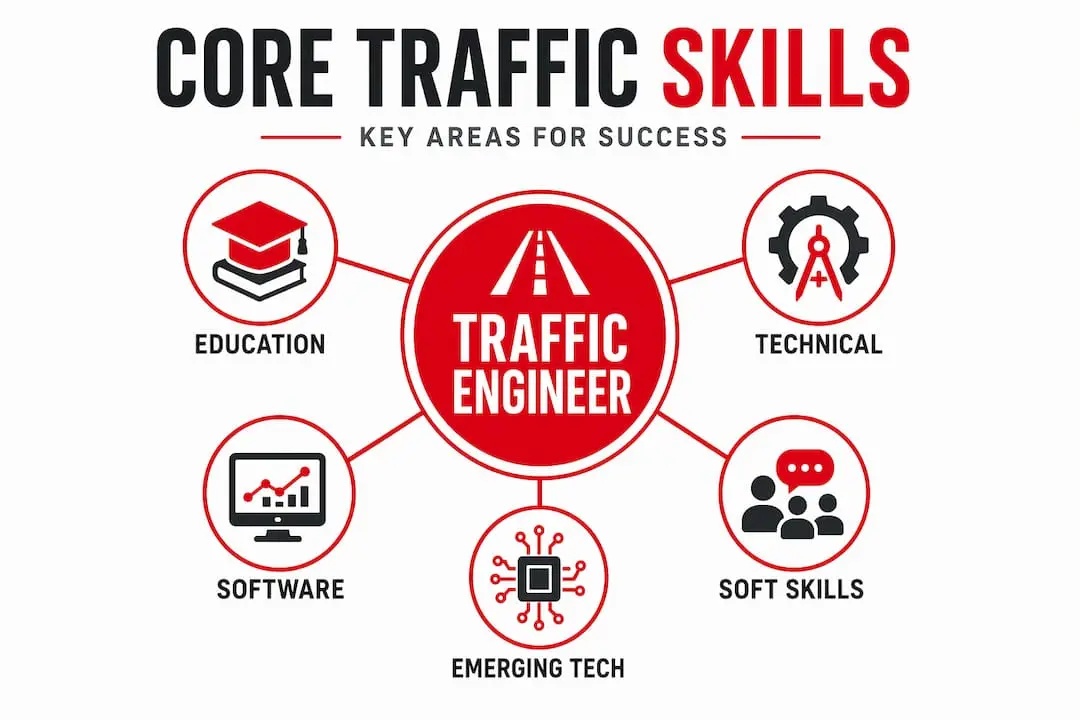
| Skill category | Practical application | Relevant certification | Key tools or methods |
|---|---|---|---|
| Education and qualifications | Foundation for all engineering roles | PE licence, Bachelor’s degree | FE and PE examinations |
| Traffic operations analysis | Capacity studies, signal timing, LOS assessment | PTOE | Synchro, HCM, SIDRA |
| Traffic simulation and modelling | Junction design validation, network performance | PTOE, PE | VISSIM, Paramics |
| ITS and emerging technologies | Connected infrastructure, adaptive signals, data systems | ITS specialist training | SCOOT, SCATS, C-V2X |
| Data analytics | Volume counts, speed profiles, crash data interpretation | None formal, but increasingly expected | ANPR data, mobile data sets |
| Soft skills and communication | Stakeholder engagement, public consultation, reporting | RSP, PTP | Presentation tools, GIS |
| Road safety | Audits, risk assessment, collision analysis | RSP | Road Safety Audit checklists |
Reviewing your traffic engineering competencies against this framework gives you a clear, structured picture of where to direct your CPD (Continuing Professional Development) efforts in 2026.
Why mastering both operational expertise and soft skills is vital for traffic engineers
The professionals who advance fastest in this industry are not necessarily the most technically gifted. They are the ones who understand that a technically perfect study is worthless if no one believes in it, acts on it, or approves it.
Many engineers make the mistake of treating PTOE certification paired with PE licensure as the finish line. In reality, these credentials are table stakes for senior roles, not differentiators. What actually differentiates the engineers who reach principal and director level is their ability to manage expectation alongside analysis. When a microsimulation model shows that a proposed development will push a junction over capacity, the traffic engineer’s job is not simply to report that finding. It is to facilitate a constructive dialogue between the developer, the local authority, and potentially the public about what mitigation is feasible, affordable, and proportionate.
That requires reading a room, managing competing interests, and maintaining technical credibility under pressure. No certification teaches you that directly. It comes from deliberate practice. Our perspective, having observed hiring patterns in this sector closely, is that engineers who actively seek out public inquiry experience, planning committee appearances, and design review panels early in their careers consistently outperform peers who stay desk-bound. The discomfort of being challenged publicly is exactly what builds the judgement employers pay for at senior levels.
Looking at career progression paths in the UK market, the pattern is consistent: technical competence gets you hired, but integrated professional capability is what gets you promoted.
How Jobs-in-Transport.com supports your traffic engineering career growth
You have built a clear picture of what traffic engineering skills you need. Now you need to put them in front of the right employers. Jobs-in-Transport.com has been connecting transport professionals with specialist employers since 2005.
Browse transport engineering job listings spanning highways, traffic management, transportation planning, and ITS roles across the UK and internationally. The platform is built specifically for professionals in this sector, so every vacancy listed is relevant to your background. You can also use the online CV tool to present your qualifications, software proficiencies, and certifications in a format that traffic engineering employers recognise immediately. The Jobs-in-Transport mission has always been straightforward: reduce the gap between skilled professionals and the roles that need them.
Frequently asked questions
What qualifications do I need to become a traffic engineer?
You generally need a Bachelor’s degree in Civil Engineering or a related field, with professional licensure and PTOE certification significantly enhancing your career prospects and eligibility for senior roles.
Which software skills are essential for traffic engineers?
Proficiency with Synchro and VISSIM modelling software is consistently required, alongside working knowledge of HCM methodologies for capacity analysis and traffic impact studies.
How important are soft skills for traffic engineers?
Public participation and collaboration are mandatory requirements on most major schemes, meaning poor communication and stakeholder management will directly delay or derail projects regardless of technical quality.
What emerging technologies should traffic engineers know?
Traffic engineers should understand ITS communications, data analytics, and cybersecurity fundamentals, including connected vehicle protocols such as DSRC and C-V2X, as these are increasingly specified in both public and private sector roles.
Does obtaining a Professional Engineering (PE) licence benefit my traffic engineering career?
Yes, a PE licence is preferred for advanced positions and is often legally required for signing off on engineering designs and reports, making it one of the highest-value credentials you can hold.


